Services
Mandrel Bending
Tight-radius bending with internal mandrel support — clean, round bends for mechanical, architectural, and OEM applications
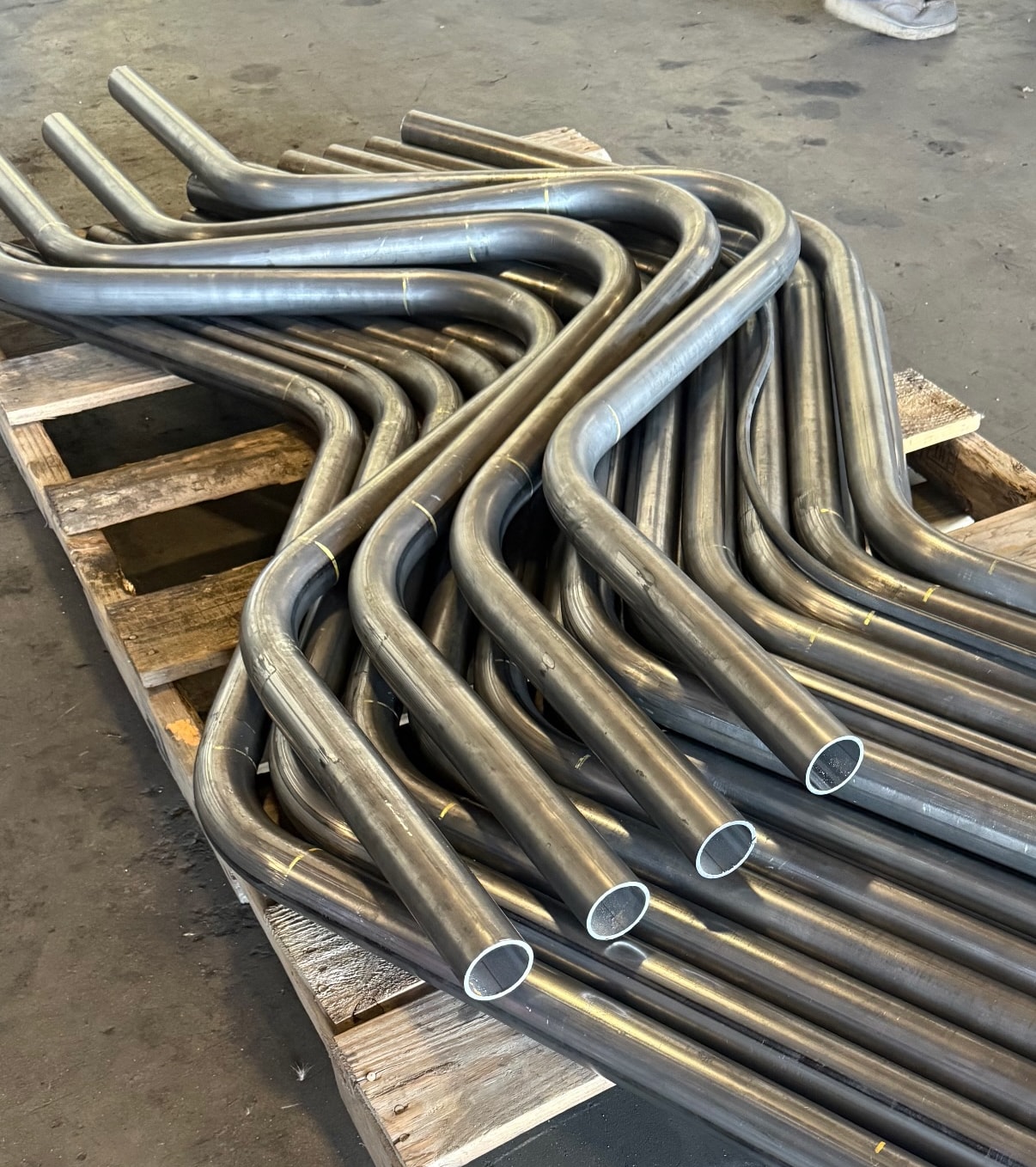
Mandrel bending uses an internal mandrel inserted into the pipe or tube during the bending process to support the wall from the inside while the bend is formed. Without internal support, the outer wall of a tight-radius bend thins and the inner wall buckles or wrinkles, and the cross-section collapses into an oval. The mandrel prevents all three failure modes simultaneously, producing a bend that is smooth on the outside, round in cross-section, and consistent in wall thickness throughout the arc.
This technique is essential when tight bend radii are required relative to the tube or pipe diameter, when the finished surface must be smooth and free of wrinkles for aesthetic or flow reasons, or when the application demands that the bore remain as close to circular as possible to maintain flow capacity or allow passage of internal components.
Data centers represent one of the fastest-growing application areas for mandrel-bent pipe and tube. Chilled water supply and return lines, condenser water loops, and refrigerant piping in data center mechanical rooms must route through tight spaces and around equipment in smooth, sweeping curves. Mandrel bending produces these curves without the pressure drop penalty of sharp elbows and without the weld joints that are potential leak points in a pressurized cooling system. Hyperscale data center operators increasingly specify bent and rolled pipe over fabricated elbow assemblies because the reduction in joints directly reduces the risk of cooling system failures that can take servers offline.
OEM manufacturers use mandrel-bent tube and pipe extensively for machine frames, fluid transfer lines, hydraulic and pneumatic circuits, heat exchanger inlet and outlet connections, and custom fabricated assemblies where the geometry is driven by the machine envelope rather than a standard building grid. The clean exterior surface and consistent bore of a mandrel bend also make it the preferred choice for any OEM application where the part will be visible, painted, or polished as part of the finished product.
Additional applications include architectural handrails and guardrails where building codes require smooth continuous bends, automotive and motorsport exhaust and intake systems, food and beverage processing equipment where sanitary bore conditions are required, and marine and offshore piping where space constraints demand tight radii.
Contact us with your pipe or tube size, wall thickness, bend radius, and angle for a quote.